Week 1
The Truth About Posture
What posture actually is, why "sit up straight" doesn't work, and the science that will change how you see your body.
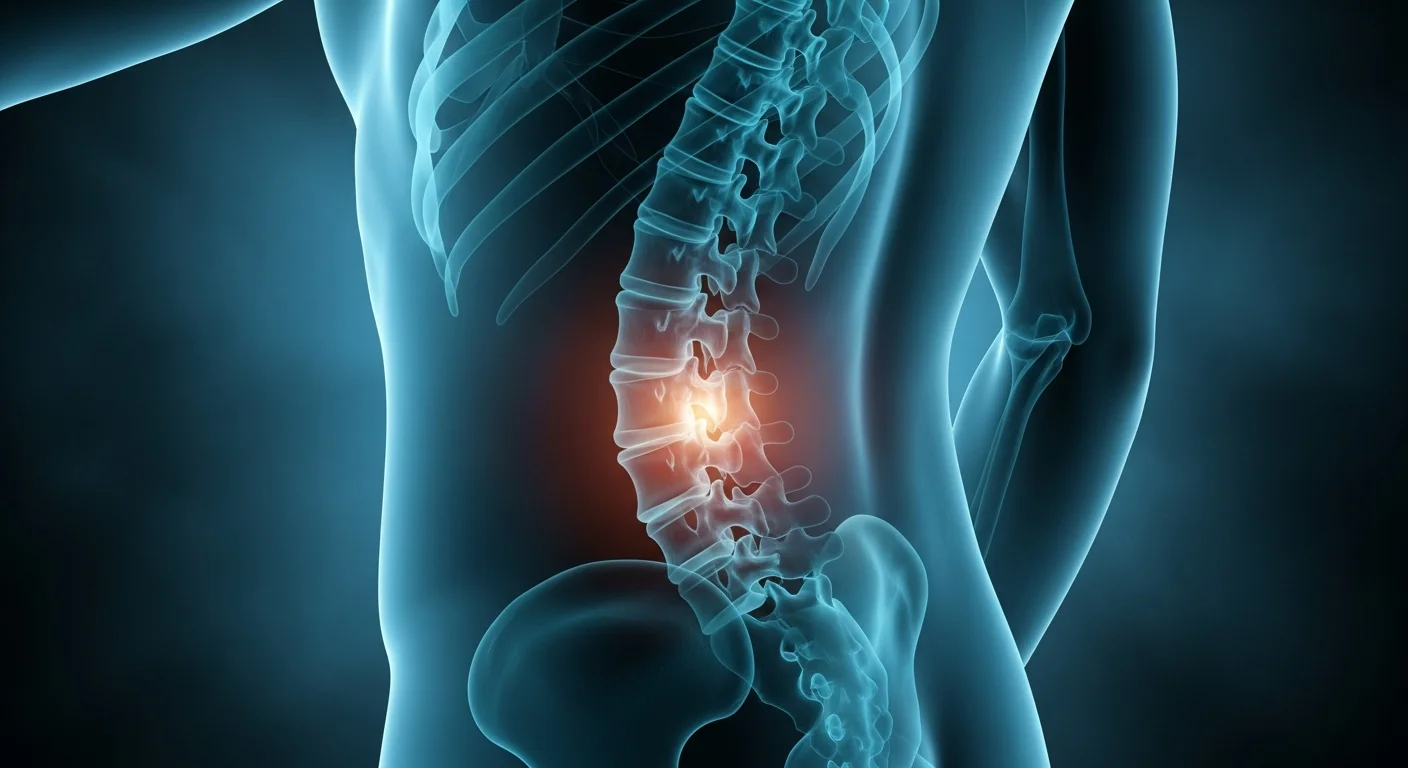
What it is, what it is not, and why everything you have been told about it is incomplete.
Sarah's Back
Sarah was thirty-four when she decided her back was broken.
Not literally — the MRI was unremarkable, her doctor said, with the kind of tone that implied she should be grateful. "Some mild disc dehydration at L4-L5, consistent with age." She was thirty-four. The disc dehydration was consistent with age. She wanted to cry in the parking lot, and she did, a little, sitting in her car with her lower back throbbing against the lumbar support she had bought off Amazon for nineteen euros.
The pain had started two years earlier as a vague tightness between her shoulder blades. She ignored it because everyone's back hurts, right? Then it migrated to her neck. Then headaches started — two, three times a week, always by mid-afternoon. Then her lower back joined the party, and suddenly she was the person who could not sit through a movie, who needed to stand at the back of the conference room, who had a foam roller and a tennis ball and a heating pad and a TENS unit and none of it was enough.
She tried massage. It helped for a day. She tried a chiropractor. It helped for an hour. She tried yoga. It helped during class and then her back seized the next morning. She tried a standing desk. She tried a kneeling chair. She tried sleeping on the floor. Each solution addressed a symptom and missed the system.
The system was her posture. Not her back. Not her discs. Not her age. Her posture — the way she had been holding her body for a decade of desk work, phone scrolling, stress, and physical inattention. Her head had migrated three inches forward. Her upper back had rounded. Her chest had collapsed, compressing her diaphragm. Her hip flexors had shortened from sitting. Her glutes had weakened from not being asked to work. Her deep core had gone quiet. Every muscle in her body had reorganized around a shape that was not aligned, and the pain was her body's way of saying: this is not sustainable.
Sarah did not have a broken back. She had a posture that was slowly undermining her.
What changed? Not a surgery. Not a magic stretch. Not a more expensive chair. What changed was understanding. Sarah learned that her pain was not a mystery — it was a message. Her body was telling her, through the only language it has, that the shape it was being asked to hold was not sustainable. Once she understood the shape and why it had formed, she could begin to change it. Not overnight. Not by forcing herself into some idealized position. But systematically, progressively, with patience and awareness.
(Sarah's experience is illustrative, not guaranteed. Individual results vary significantly. Continue reading to understand why — and what your own journey might look like.)
If this sounds familiar, keep reading.
What Posture Actually Is
Let us start by dismantling something. When someone says "good posture," the image that comes to mind for most people is a military brace — shoulders thrown back, chest puffed out, chin up, lower back arched, standing at rigid attention. This image is wrong, and chasing it has done more harm than good.
Good posture is not a position. It is a relationship.
It is the relationship between your body and gravity — the way your skeleton stacks, the way your muscles support that stack, and the way both adapt dynamically as you move through your day. Stuart McGill, one of the world's foremost spine biomechanists, describes optimal posture not as a single perfect position but as the ability to maintain a "neutral spine" — the natural curves of the cervical, thoracic, and lumbar spine preserved under varying loads and conditions (McGill, 2015). Your spine has curves for a reason. They absorb shock, distribute force, and create resilience. Good posture does not eliminate these curves. It respects them.
Esther Gokhale, whose research into "primal posture" studied populations with very low rates of back pain, found something that challenges the Western model entirely. In traditional cultures where people squat, carry loads on their heads, and sit on the ground rather than in chairs, the spine is longer, the pelvis is anteverted (tipped slightly forward), and the shape of the back resembles a J-curve rather than the S-curve taught in Western anatomy textbooks (Gokhale, 2008). What Gokhale describes as "stacksitting" and "stretchsitting" are not rigid positions — they are relationships between the pelvis, spine, and head that allow the skeleton to do the work of holding you up, so your muscles can stop.
This is the key insight: when your posture is truly aligned, it requires less effort, not more. If "sitting up straight" feels like an exhausting effort that you cannot maintain, it is because you are using muscles to hold yourself in a position that your skeleton should be handling. You are fighting your structure instead of using it.
Kelly Starrett, in Becoming a Supple Leopard (Starrett, 2015), describes this as "positional integrity" — the ability to organize your body in a way that is mechanically sound and sustainable. Here is how Starrett asks you to think about it: before you pick up a barbell, before you run a mile, before you sit at your desk, organize your body. Screw your feet into the floor to create an external rotation force at the hips. Squeeze your glutes to set the pelvis. Brace your core to stabilize the spine. Set your shoulders by externally rotating the arms. Then, from this organized position, begin the task. The organization comes first. The task comes second. Most people have this backward — they begin the task and hope the organization follows. It does not.
Think of posture as a stack of blocks. When the blocks are centered — ankles under knees, knees under hips, hips under ribs, ribs under shoulders, shoulders under ears — the stack is stable. Gravity flows straight down through the center and each block rests securely on the one below it. Now shift the top block forward by three inches. Suddenly the whole stack needs external support to keep from toppling. That external support is your muscles. Your upper back muscles. Your neck extensors. Your hip flexors. They are working overtime, all day, every day, to keep your poorly stacked blocks from collapsing. And they are tired. And they hurt. And you think the problem is in the muscles when the problem is in the stack.
This is what the kinetic chain means in practice. Your body is not a collection of independent parts — it is an interconnected chain where everything affects everything else. Your forward head posture is not just a neck problem. It changes the curve of your upper back, which changes the position of your ribcage, which changes how your diaphragm works, which changes how you breathe, which affects your nervous system, which influences your stress levels, which increases your muscle tension, which worsens your posture. It is a loop. And the loop runs in both directions — which is why fixing your posture may improve your breathing, your stress, your energy, and your mood. Not metaphorically. Physiologically. Research suggests that posture changes can influence these systems, though individual responses vary (Nair et al., 2015; Wilkes et al., 2017).
Why "Sit Up Straight" Does Not Work
You have heard it a hundred times. You have tried it a hundred times. You pull your shoulders back, lift your chest, tuck your chin — and within sixty seconds, you are right back where you started. This is not a willpower failure. It is a strategy failure.
"Sit up straight" fails for three reasons:
First, it targets the symptom, not the cause. Telling someone with forward head posture to pull their head back is like telling someone with a flat tire to drive straighter. The head is forward because of a chain of events — tight chest, weak mid-back, inhibited deep neck flexors, shortened hip flexors pulling the pelvis under, which rounds the lumbar spine, which rounds the thoracic spine, which pushes the head forward to keep the eyes level. Pulling the head back without addressing the chain just adds another compensation on top of the pile.
Second, it asks muscles to do skeleton's job. When you "sit up straight" by muscling yourself into position, you are asking your erector spinae and upper traps to hold you in alignment through constant contraction. Muscles fatigue. Skeletons do not. Sustainable posture comes from stacking your bones correctly and letting your muscles relax into support roles, not starring ones.
Third, it creates a distorted model of what "straight" means. Most people, when told to sit up straight, overcorrect — they arch their lower back, flare their ribs, retract their shoulder blades to the point of strain, and create a position that is just as far from neutral as their slouch was, just in the opposite direction. They trade one dysfunction for another and then wonder why it hurts.
Stuart McGill's concept of "spine hygiene" offers a better framework (McGill, 2015). Rather than thinking about posture as a position to achieve, think of it as a set of movement habits to cultivate. Spine hygiene means: avoid prolonged static positions. Move frequently. Maintain your spine's natural curves under load. Build capacity in your stabilizing muscles so they can do their job without fatigue. And most importantly, understand that your best posture is your next posture — the one you are about to change into, because no single position, no matter how "correct," is meant to be held for eight hours.
The Pain-Posture-Mood Connection
Here is something that might change how you think about posture forever: it is not just about pain. It is about who you are.
Research on posture and psychological state has demonstrated that body position can influence self-reported feelings of confidence and stress. Amy Cuddy's initial research on "power poses" (Cuddy et al., 2010) suggested that expansive, open postures increase feelings of power and confidence, while collapsed, closed postures have the opposite effect. It is worth noting that the original hormonal findings — specifically that power poses increase testosterone and decrease cortisol — have faced significant replication challenges (Ranehill et al., 2015). However, the self-report findings on subjective feelings of confidence and power have been more consistently replicated (Cuddy et al., 2018). The key insight stands: how you hold your body influences how you feel, even if the precise hormonal mechanism remains under investigation.
This matters practically. When you spend eight hours a day in a collapsed posture, you are not just straining your muscles. You may be influencing the biochemical environment in which your mood and confidence operate. Your body is not just reflecting how you feel — it may be contributing to how you feel.
Lorimer Moseley, a leading pain neuroscientist, takes this even further. In Explain Pain (Moseley & Butler, 2015), he describes how chronic pain is not just a signal from damaged tissue — it is a construct of the brain, influenced by context, expectation, stress, mood, and yes, posture. Your brain decides how much pain to produce based on how threatened it perceives you to be. A body that is chronically held in a protective, closed, compressed posture may signal threat. A body that is open, aligned, and breathing fully may signal safety. This does not mean your pain is "in your head." It means your posture is one of the inputs your brain uses to calibrate your pain experience — and it is an input you can change.
This is why Spireflex is not just an exercise program. Stretching your chest and strengthening your back will help your posture. But understanding that your posture is connected to your pain, your breathing, your stress, your confidence, and your emotional state — that is what makes change stick. You are not just fixing a mechanical problem. You are changing the way you inhabit your body. And that changes everything.
How Modern Life Shapes Posture
It is worth being specific about this, because the challenge is not laziness — it is environment.
The chair problem. Humans are not designed to sit in chairs. For the vast majority of human history, people squatted, knelt, sat cross-legged on the ground, or stood. The chair — especially the modern office chair with its padded seat, backrest, and armrests — creates a specific set of conditions: the hip flexors shorten (because the hips are at 90 degrees), the glutes shut off (because they are compressed and unloaded), the pelvis tilts posteriorly (because the soft seat and backrest encourage slumping), and the spine loses its natural curves. Gokhale's research in traditional cultures — where people sit on the ground, carry loads on their heads, and spend hours squatting — found dramatically lower rates of back pain (Gokhale, 2008). The difference is not genetic. It is postural.
The screen problem. Every screen you interact with pulls your body forward. The computer screen at eye level is actually the least problematic — but few people position it correctly. Laptops, which require you to look down and reach forward simultaneously, are postural disasters. Phones, which you hold in your lap and crane your neck toward, apply devastating loads to the cervical spine. TVs mounted above eye level force the head into extension. The constant thread: every screen demands visual fixation, and your body will rearrange itself in whatever way necessary to keep your eyes on the target. If the target is below eye level, your body folds. It is that simple.
The shoe problem. Most modern shoes — especially those with elevated heels, narrow toe boxes, and rigid soles — change the mechanics of your foot, which changes your ankle, which changes your knee, which changes your hip, which changes your spine. A one-inch heel elevation shifts your center of gravity forward, requiring your entire body to compensate to avoid falling on your face.
Katy Bowman, a biomechanist and author of Move Your DNA (Bowman, 2014), has written extensively about how footwear reshapes the body from the ground up. A shoe with a toe box narrower than the natural width of the foot compresses the toes, weakening the intrinsic foot muscles that support the arch. A rigid sole prevents the 33 joints in each foot from moving — joints that are designed to articulate with every step, sensing the ground and transmitting information up the chain. A cushioned sole dampens the sensory feedback that your feet provide to your balance system, forcing your body to rely more on vision and the vestibular system for balance.
You do not need to go barefoot. But understanding that your shoes are a postural variable is important. If you wear heeled shoes for work, consider flat shoes for your commute and home. If you spend most of your day in rigid shoes, spend time barefoot at home to let your feet wake up. The transition to minimalist footwear, if you choose to explore it, should be gradual — your feet have adapted to their shoe environment just as your spine has adapted to your chair, and sudden changes can cause injury. Start with short periods of barefoot walking on soft surfaces and progress slowly over months.
The stress problem. The modern environment is not just physically misaligned — it is neurologically overstimulating. The combination of constant information, artificial light, insufficient sleep, sedentary work, processed food, and social pressure creates a baseline stress level that keeps the nervous system in a chronic low-grade fight-or-flight state. This state creates physical tension — particularly in the neck, jaw, shoulders, and hip flexors. You cannot separate postural health from nervous system health. They are the same system, viewed from different angles.
Exercise 1: The Posture Self-Assessment
Before you change anything, you need to see where you are. This assessment takes about ten minutes and gives you a baseline you will return to throughout the program.
️ Safety Note: This is an assessment, not a treatment. Move gently and do not force any position. If standing against a wall causes pain, step away. If any position feels uncomfortable, note it and move on. This assessment is about observation, not endurance.
Part A: The Wall Test
- Stand with your back against a flat wall. Place your heels about two inches from the baseboard.
- Let your body settle naturally against the wall. Do not try to "fix" anything — just stand the way you normally would and let the wall catch you.
- Notice what touches the wall and what does not:
- Head: Does the back of your head touch the wall, or is there a gap? If there is a gap, how many fingers can you fit between your head and the wall? One finger? A fist? This gap represents your forward head posture.
- Upper back: Does your upper back touch the wall? Does it feel like you have to force it, or does it rest there naturally?
- Lower back: Place your hand flat between your lower back and the wall. Is there a small, natural gap (about the thickness of your flat hand)? That is normal. A larger gap suggests excessive lumbar lordosis. No gap at all suggests a flattened lumbar curve.
- Buttocks: Do both sides touch the wall equally? Is one side touching more than the other?
- Shoulders: Do both shoulder blades touch the wall? Are they even?
- Write down what you notice. Be specific.
Part B: The Mirror Check
- Stand in front of a full-length mirror in form-fitting clothing (or underwear). Face forward.
- Look at yourself with fresh eyes — as if you are seeing a stranger. Notice:
- Are your shoulders level, or is one higher than the other?
- Does your head tilt to one side?
- Are your hands hanging at the same position, or is one more forward or rotated?
- Do your kneecaps point straight forward or angle inward or outward?
- Now turn sideways. Look at your profile:
- Is your ear directly over your shoulder, or in front of it?
- Is your shoulder directly over your hip?
- Can you see a curve in your upper back? How pronounced is it?
- Does your belly push forward (indicating anterior pelvic tilt)?
- Write down what you notice.
Part C: The Photo Assessment
- Ask someone to take two photos of you: one from the front and one from the side. Stand the way you naturally would — do not pose.
- On the side-view photo, draw (or imagine) a vertical line from your ear straight down. In ideal alignment, this line would pass through:
- The middle of your shoulder
- The middle of your hip
- Just behind your kneecap
- Just in front of your ankle bone
- Notice where your body deviates from this line. These deviations are your postural patterns — they are what this program will address.
- Save these photos. You will retake them at Week 6 and Week 12.
Exercise 2: The 3-Minute Reset
This is a simple sequence you can do right now — and every day going forward. It is not a cure. It is a pattern interrupt. It briefly takes your body out of its habitual position and reminds it that other positions exist.
️ Safety Note: These are gentle movements. Do not force any stretch. If overhead reaching causes shoulder pain, reach only as high as is comfortable. If you have a shoulder injury or impingement, skip the overhead reach and focus on the chest opener and chin tuck.
Modifications for limited mobility:
- Seated version: All three steps can be performed seated in a firm chair.
- Reduced range: If reaching overhead is not possible, reach forward and up at 45 degrees instead.
- Using a strap: If you cannot clasp hands behind your back in Step 2, hold a towel or resistance band between your hands to bridge the gap.
Step 1: The Reach and Breathe (60 seconds)
- Stand with your feet hip-width apart, weight evenly distributed.
- Interlace your fingers and reach your arms overhead, palms facing the ceiling.
- Push your palms up and slightly back, feeling a stretch through your chest, ribcage, and the front of your shoulders.
- Take five slow breaths in this position. Each inhale: expand your ribs sideways, not just forward. Each exhale: grow a little taller.
- On the last exhale, slowly lower your arms.
Step 2: The Chest Opener (60 seconds)
- Clasp your hands behind your back. If you cannot reach, hold a towel or strap between your hands.
- Gently squeeze your shoulder blades together and lift your hands away from your back.
- Keep your ribs from flaring — think of drawing your front ribs down toward your pelvis as you open your chest.
- Hold for five breaths. With each exhale, see if you can open a little more without forcing.
Step 3: The Chin Tuck and Nod (60 seconds)
- Stand tall (or sit on the edge of a chair with feet flat on the floor).
- Without tilting your head up or down, gently draw your chin straight back — as if making a double chin. You should feel a stretch at the base of your skull and a lengthening sensation through the back of your neck.
- Hold for five seconds. Release. Repeat five times.
- Then: keeping the chin tucked, slowly nod your head forward about twenty degrees — a small, gentle nod. This activates the deep neck flexors, the muscles that should be holding your head in position but are probably weak and inhibited.
- Hold the nod for five seconds. Release. Repeat five times.
That is three minutes. Do it once a day — more if you can. Every time you do it, you are casting a vote for a different shape.
Journaling Prompts: Week 1
Grab a notebook, open a notes app, or use the margins of this page. Spend five to ten minutes writing on one or more of these prompts. This is not therapy — it is body awareness training for your mind.
- Describe your posture in your own words. Not clinical terms — feelings. What does it feel like to be in your body right now? Where is there tension? Where is there ease? Where is there numbness or absence of sensation?
- When did you first become aware of your posture? Was it a comment from someone? A photo? A pain that got your attention? What story have you been telling yourself about your posture since then?
- What has poor posture cost you? Energy? Confidence? Freedom from pain? The ability to sit through a movie? Be specific. Not what it might cost in the future — what has it already taken from you?
- Imagine standing in a room as the most aligned version of yourself. Not rigid — aligned. Tall, open, breathing fully. How does that person feel? What is different about how they move through the world? Write about that version of yourself as if they already exist.
Weekly Reframe
Your posture is not a punishment for sitting too much. It is information. It is your body's record of how you have lived — the hours at the desk, the stress you carried, the attention you did or did not give to the physical home you live in. You cannot change the record. But you can start writing a new one. Today.
Sarah Check-In: Week 1
Sarah took the quiz and scored a clear D with secondary A — a Desk Prisoner who had never really paid attention. Her wall test revealed a three-finger gap behind her head. Her side-profile photo shocked her: she looked, she said later, "like I was trying to read the future." She wrote in her journal that night: "I had no idea I looked like this. I think I've been avoiding side-view photos for years and I only just realized why."
Profile-Specific Notes: Week 1
Desk Prisoner (D): Your wall test will likely reveal a significant gap between your head and the wall. This is your starting point, not your verdict. During the 3-Minute Reset, pay extra attention to the chin tuck — the deep neck flexors it activates are the muscles that will eventually hold your head where it belongs.
Chronic Compensator (C): During the mirror check and photo assessment, pay close attention to asymmetry — one shoulder higher, hips uneven, weight shifted. Write down specifically what you see. You are building a map of your compensations, and awareness of the full pattern is more important for you than for any other profile.
Stress Holder (S): You may find the wall test uncomfortable — not physically painful, but emotionally activating. Standing with your back against a wall and trying to relax into it can feel exposing for people who carry tension as armor. Notice your breathing during the assessment. If it gets shallow or you hold your breath, that is data, not failure.
Awareness Gap (A): The entire point of this week for you is the assessment. The exercises are useful, but the real work is seeing yourself. Look at the photos with curiosity, not judgment. You are meeting your posture for the first time. Some of what you find will surprise you. Let it.